Mastering the Perfect Restaurant Receipt Format
A good restaurant receipt format is your final, official word with a customer. It’s the document that spells out everything from their appetizer to the final total. Think of it as more than just a slip of paper—it’s a critical tool that keeps you legally compliant, builds customer trust, and helps your operations run smoothly.
What Actually Goes on a Restaurant Receipt?
The restaurant receipt is like the final handshake after a great meal. It needs to be clear, professional, and dead simple to understand. Sure, it's proof of payment, but it also serves as a communication tool, a legal document, and even a tiny piece of your brand. A well-designed receipt leaves no questions asked and solidifies a positive dining experience.
A great receipt breaks down every single charge, showing complete transparency. At its core, a solid restaurant receipt needs to include your restaurant's name and contact info, the date and time, the server's name, and an itemized list of what the customer ordered. It should also clearly show the price of each item, the subtotal, the tax rate and amount, the final total, how they paid, and a spot for a tip. This is standard whether you're using a gas receipt or a detailed hotel receipt.
These details aren't just for show; they're essential for meeting tax and accounting rules and, just as importantly, for building trust with your guests. You can learn more about creating a compliant restaurant receipt to dive deeper into the specifics.
The Anatomy of a Receipt
Every professional receipt, no matter how simple or complex, is built on three key sections: the Header, the Body, and the Footer. Each one has a specific job to do, from telling customers who you are to wrapping up the final payment details.
This infographic breaks down that classic three-part structure.
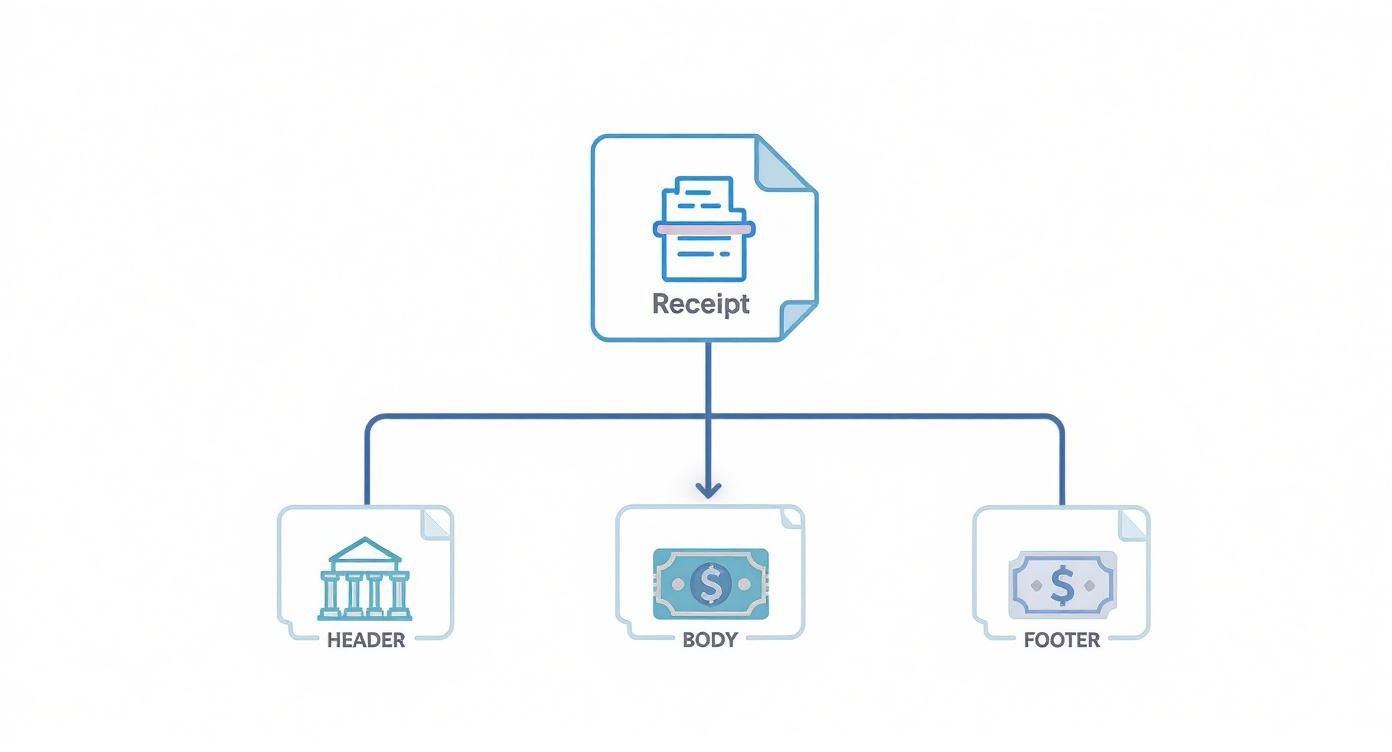
As you can see, organizing the information this way is the secret to a clear and effective restaurant receipt format. The header sets the stage with your brand, the body provides the play-by-play of the transaction, and the footer handles the financial wrap-up.
Here’s a quick rundown of what goes where to ensure your receipts are always professional and compliant.
Anatomy of a Professional Restaurant Receipt
This table breaks down the must-have components that every restaurant receipt needs to be clear, compliant, and customer-friendly.
| Component Category | Specific Information Required | Why It Matters |
|---|---|---|
| Header | Restaurant Name, Address, Phone Number, Website, Logo | Immediately identifies your business and makes it easy for customers to contact you. |
| Body | Date & Time, Order/Receipt Number, Server Name, Itemized List (Items, Quantities, Prices) | Provides a transparent, detailed record of the transaction for both parties. |
| Footer | Subtotal, Tax (Rate & Amount), Gratuity/Tip Line, Discounts, Total Amount, Payment Method Details | Clearly explains the final cost, fulfills tax obligations, and finalizes the payment. |
This fundamental structure—Header, Body, Footer—creates a complete and professional record for both you and your customer. It’s a timeless layout that works whether you're a busy diner using a classic diner receipt or a coffee shop using a simple cafe receipt template.
Why Your Receipt Format Is a Business Power Tool
Think of that little slip of paper you hand over at the end of a meal. It’s easy to dismiss it as just a record of the transaction, but in reality, it’s one of the most underrated tools in your restaurant's entire operation. A well-thought-out restaurant receipt format is a workhorse, quietly handling legal compliance, shaping the customer experience, and even giving you valuable insights into your business.
First and foremost, this document is your shield for legal and tax matters. When it comes to financial reporting or—heaven forbid—an audit, detailed receipts are your best friend. They are the concrete proof of your revenue, they validate your expenses, and they show you’ve handled taxes and tips correctly, saving you from headaches and potential penalties down the line. A clear itemized receipt is crucial for this.
Enhancing the Customer Experience
Beyond the books, a clear receipt format has a direct impact on how a customer feels when they leave your restaurant. A jumbled, confusing bill can instantly put a damper on a fantastic dining experience, leading to awkward questions, payment delays, or just a lingering sense of frustration. Clarity builds trust.
A well-designed receipt is an extension of your customer service. It answers questions before they are asked, reinforces transparency, and ensures the final interaction a customer has with your brand is a positive and professional one.
And don't forget, that little piece of paper can also be a subtle marketing tool. A simple thank-you message, a QR code linking to a feedback survey, or a small discount for a future visit can turn a forgettable transaction into a reason for customers to come back. It’s a simple way to gather feedback and build loyalty.
Driving Operational Efficiency
Finally, let's talk about how a standardized receipt makes life easier behind the scenes. When every transaction is recorded in the same clean, easy-to-read layout, your bookkeeping becomes faster and far less error-prone. This consistency is a game-changer for accurate daily, weekly, and monthly financial check-ins.
These standardized receipts are also a goldmine of data for business analysis. You can use them to:
- Track Sales Trends: Quickly see which dishes are flying out of the kitchen and which ones are collecting dust. This helps you make smarter decisions about your menu and inventory.
- Monitor Server Performance: Get a clear picture of individual server sales, allowing you to reward your top performers and identify team members who might benefit from a little extra training.
- Simplify Expense Reporting: For your business-lunch crowd, a professional receipt is a must. Providing something clear like a pre-formatted restaurant receipt template makes it incredibly easy for them to file their expenses, which makes your establishment look great.
By creating a consistent layout—whether it's for a simple cafe receipt or a more complex diner bill—you're building a system that supports your finances, marketing, and daily operations all at once.
Choosing the Right Receipt for Any Situation
Your restaurant receipt format shouldn't be a one-size-fits-all solution. Why? Because a quick coffee to-go is a world away from a big sit-down dinner party. Customizing your receipt for the situation is a small touch that clears up confusion, streamlines your operations, and just makes good sense.
Think of it like this: you wouldn't greet a customer at a fine-dining spot the same way you would at a fast-food counter. Your receipt is your final piece of communication, so it should also match the context of the meal. It's a small detail that has a big impact on both the customer experience and your own sanity when it comes to record-keeping. A coffee shop receipt will naturally differ from a fine dining receipt.
Let's walk through three of the most common scenarios you'll run into and figure out the perfect receipt for each.
The Standard Dine-In Receipt
This is your classic receipt, the one for guests who sit down and enjoy a meal in your restaurant. Its most important job is to give a crystal-clear, itemized breakdown of everything they ordered. When that bill hits the table, you want zero confusion—just transparency.
For a standard dine-in receipt, scannability is everything. The layout needs to be simple, with each dish and drink on its own line right next to its price. This format is the bread and butter for most casual eateries. A perfect example of this in action is this simple diner receipt template.
A solid dine-in receipt must have these key elements:
- Itemized List: Every single thing ordered, from the first appetizer to the last dessert, listed out one by one.
- Server Identification: The name or ID of the server who took care of the table.
- Clear Tip Line: A dedicated spot for guests to add a gratuity, often with helpful suggested percentages like 18%, 20%, or 22%.
The Takeaway or Delivery Receipt
When your food walks out the door, the receipt has a few extra jobs to do. It’s no longer just a bill—it’s now a packing list and a tracking document all in one. The customer isn't sitting at a table where they can flag someone down with a question, so the receipt has to give them everything they need right away.
This format requires a bit more detail than its dine-in cousin. It should always include a customer order number, which is a lifesaver for both your kitchen staff and the customer waiting for their food. For quick-service spots that crank out a ton of to-go orders, a clean cafe receipt format can be easily tweaked for this purpose. A dedicated food truck receipt can also work well here.
A takeaway receipt is the bridge between your kitchen and the customer's home. It must confirm the order's accuracy and provide contact details in case of any issues, ensuring a smooth off-premise experience.
The Split-Check Receipt
Ah, the split check. It can be a server's nightmare and a customer's biggest frustration if it’s not handled well. A properly formatted split-check receipt is your secret weapon for avoiding arguments and making sure everyone pays their fair share without a 10-minute huddle over the bill.
The entire goal is to divide the items, taxes, and suggested tips clearly and accurately among each person. Every guest should get a receipt showing only what they ordered, along with their portion of the tax and a final total. This simple act of organization prevents disputes and makes paying the bill painless. If you're looking for ideas, you can find a huge variety of customizable options among these professional receipt templates that can be adapted for any scenario.
Designing a Receipt People Can Actually Read
A confusing receipt can completely ruin an otherwise great meal. After you've gathered all the necessary details, the real trick is putting them together in a layout that's clean, professional, and easy to understand at a glance. Good design isn't just for looks; it builds trust and makes paying the bill a smooth, painless process.
The secret to a readable restaurant receipt format is a clear hierarchy. Think of it like telling a story. You start at the top with your branding—logo, name, and contact info—so they instantly know who it's from. You end at the very bottom with the payment details, neatly tying up the financial transaction. This simple top-to-bottom flow guides your customer's eyes right where they need to go. Even a parking receipt follows this fundamental structure.
Creating a Clean and Professional Layout
Nothing kills clarity faster than clutter. When a receipt is cramped and messy, customers have to hunt for information, leading to frustration and questions that tie up your staff. The best way to fix this? Use white space.
White space isn't just empty space; it's a powerful design tool. By leaving a little room around the edges and between sections, you make the entire document breathe. It suddenly feels more organized and way less intimidating.
This one simple change can take a jumbled mess of text and turn it into something that looks polished and professional. It helps each part of the receipt—the food items, the subtotal, the tax—stand on its own, making the whole thing easier to scan.
Choosing the Right Typography
The fonts you pick matter more than you might think. Always go for simple, clean typefaces that are easy to read, especially on that thin receipt paper. Steer clear of fancy script or decorative fonts where numbers and letters can get muddled. A little consistency goes a long way, too—maybe one font for headings and another for everything else to create a subtle structure.
Here are a few typography rules to live by:
- Use Bold Text Where It Counts: Make the most important numbers pop. The Subtotal, Tax, and especially the Total Due should be in bold to draw the eye immediately.
- Keep Font Size Readable: The text needs to be big enough for someone to read without squinting. Sure, a tiny font saves paper, but it makes for a terrible customer experience.
- Go for High Contrast: There's a reason black text on a white background is the classic choice—it works. Make sure your printer ink is fresh so the text is crisp and dark, not faded and blurry.
By focusing on a clear hierarchy, smart use of white space, and clean typography, you create a receipt that helps your customer, not confuses them. For a fantastic example of a layout that nails all these fundamentals, check out this versatile generic POS receipt template.
From Hand-Scrawled Chits to Digital Slips: A Brief History of the Receipt
The restaurant receipt we know today didn't just pop into existence. It evolved right alongside the dining industry, transforming from a simple handwritten note into the detailed, data-packed slip we get from the printer. Looking back at this journey shows us why our receipts are designed the way they are—it’s a story about the growing complexity and professionalism of running a restaurant.
Think back a few decades. A restaurant bill was often nothing more than a "chit," a small piece of paper with a single number scribbled on it. No itemized list, no tax breakdown, and definitely no logo. This system worked fine when menus were simple, transactions were cash-only, and record-keeping was more of an afterthought. A simple cash sale receipt is the modern equivalent.
The Shift to Detailed Records
As the restaurant business got more serious, the need for better paperwork grew. The invention of the cash register in the late 1800s was a game-changer, giving owners a way to accurately track what they sold. This was the first major step toward the structured, itemized receipts that are now the standard.
This period also gives us a fascinating glimpse into how much dining has changed. For instance, old receipts from the early 20th century reveal some truly wild prices. In 1914, you could get a full Sunday dinner at a Chicago café—oysters, poultry, wine, and all—for just 75 cents. You can find more of these amazing historical tidbits about old restaurant prices that show just how far we've come.
The story of the receipt is really the story of the restaurant industry growing up. Every new line item—from sales tax to the server's name—was added to meet new legal, financial, or customer service needs.
The Digital Leap Forward
The most dramatic change, of course, was the digital revolution. Point-of-sale (POS) systems took the humble receipt and turned it into a powerful business tool. All of a sudden, receipts could be printed in a flash, automatically track inventory, and feed valuable data back to the owner. This technology made tricky things like splitting a check or applying a happy hour discount totally painless.
Today, a solid restaurant receipt format is non-negotiable. It doesn't matter if you're running a fine-dining spot or a food truck; the core principles of clarity, accuracy, and professionalism are the same. Thankfully, tools like a flexible restaurant bill template or a specialized bar receipt format make it easy for any business to create documents that reflect this long history of getting it right.
Create Your Own Professional Receipt in Minutes
Alright, now that you’ve got the theory down on what makes a great restaurant receipt, let's get practical. You don't need to be a graphic designer or a software wizard to create a receipt that looks clean, professional, and ticks all the right boxes. With a good online tool, you can knock this out in the time it takes to brew a pot of coffee.
Something like ReceiptMake.com takes all the guesswork out of the process. It's built to help you pick a template, plug in your details, and walk away with a perfect receipt. It’s a huge time-saver, and that’s time you can pour back into running your business.
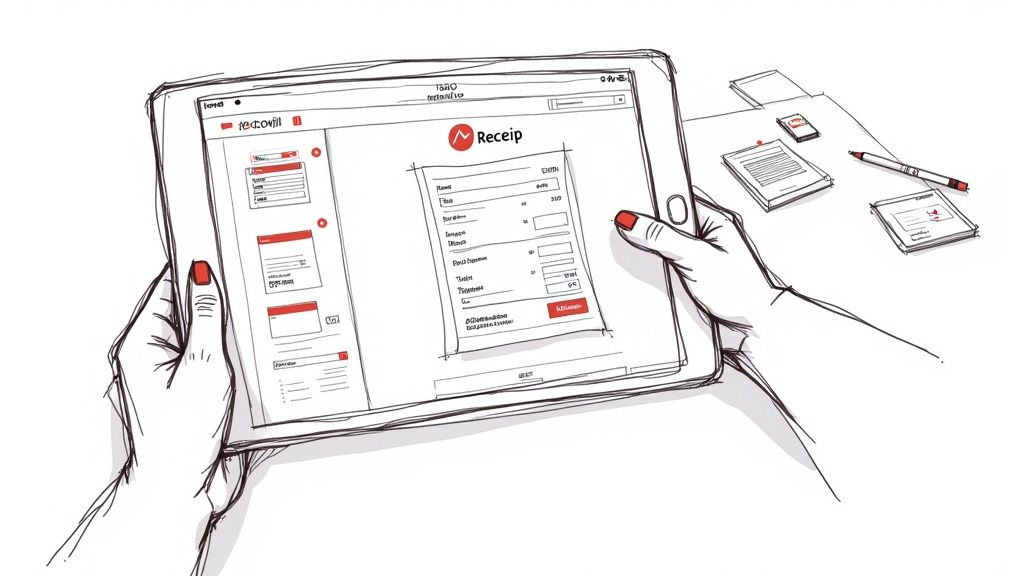
The layout is super intuitive. You just type in your information on the left side of the screen, and you can watch your receipt come to life on the right. This live preview means you see exactly what you're getting, so there are no surprises when you hit print.
A Quick Step-by-Step Guide
The whole point is to be fast and painless. You can honestly go from zero to a finished, professional-looking receipt in less than five minutes.
Here’s the basic rundown:
Pick Your Template: First things first, choose a design that matches your restaurant's vibe. Are you a casual cafe or an upscale bistro? There are templates for every style, from a basic sales receipt to a detailed invoice receipt.
Add Your Branding: Pop in your restaurant's name, logo, address, and phone number. This is your chance to make the receipt distinctly yours and reinforce your brand every time a customer gets one.
List the Items: This is the core of the receipt. Add each dish and drink on a separate line with its quantity and price. The tool handles all the math, calculating the subtotal automatically so you don't have to worry about errors.
Tally Up the Final Bill: Enter your local sales tax rate, and the final total will update instantly. This is also where you can add a line for tips or factor in any discounts you've offered.
Download and Go: Once you're happy with how it looks in the preview, just download the receipt. It comes out as a crisp PDF, ready to print or email straight to your customer. For a classic restaurant feel, this restaurant bill template is a fantastic place to start.
A Few Common Questions, Answered
When you get down to the nitty-gritty of receipt formatting, a few questions always pop up. Getting the answers straight helps keep your business compliant and your daily operations headache-free. Let's clear up some of the most common ones.
Do I Legally Have to Give Customers a Receipt?
In short, yes—it's always the best move. While the specific rules can change depending on where you are, handing over a receipt when a customer asks for one is a standard requirement just about everywhere.
For your own records, especially when it comes to taxes, receipts are your golden ticket. They're the proof you need to back up your sales if an auditor ever comes knocking. Plus, they give customers a clear record of what they paid for, which is just good business. The safest bet? Just make it a habit to issue one for every single transaction.
What’s the Real Difference Between a Receipt and an Invoice?
It's easy to get these two mixed up, but the distinction is simple. Think of it like a conversation: an invoice asks, and a receipt confirms.
An invoice is a request for payment. It’s the detailed bill you bring to the table before the customer pays. A receipt, on the other hand, is proof that the payment has already been made. It’s the final slip you give them after they've settled up.
So, in a restaurant, the bill is the invoice, and the final printout after their card goes through is the receipt. A good payment receipt template makes this final step clear.
Can I Just Send Digital Receipts Instead of Printing Paper Ones?
Absolutely! Digital receipts are a great, eco-friendly option and are becoming more and more common.
They are completely valid as long as they contain all the same critical info you’d find on a paper version—your restaurant's details, the itemized list, totals, and payment confirmation. The key is making sure you have a secure way to send them and that you (and your customer) can easily access them later. Most modern POS systems do this for you.
If you’re looking to create digital receipts, a customizable bar receipt template can be a fantastic starting point. Or, for something straightforward that works for both digital and print, a solid generic receipt template has you covered.
Ready to stop fussing with formatting and just make great-looking receipts? With ReceiptMake, you can generate a professional, compliant receipt in a matter of seconds. Pick from over 100 templates and create your own at https://receiptmake.com.

