Restaurant receipt form: Design a Pro, Print-Ready & Brand-Consistent
A restaurant receipt form is so much more than a simple slip of paper. Think of it as your final handshake with a customer—a critical business document that reflects the quality of your entire establishment. A well-designed receipt builds trust, keeps you legally compliant, and makes your bookkeeping a whole lot easier.
Why a Great Receipt Is a Business Essential
Your receipt isn't an afterthought; it's the final touchpoint in the dining experience. For your customers, a clear, professional receipt cuts through any confusion and makes it simple for them to handle their own expense reporting. For your business, it’s an indispensable record for everything from daily accounting to tracking inventory.
A poorly designed receipt can create real headaches. It can lead to disputes over confusing charges or make it a nightmare for your team to reconcile the day's sales. On the flip side, a thoughtfully created receipt reinforces your brand’s professionalism and attention to detail long after the meal is over.
More Than Just Paper
The humble restaurant receipt has evolved into a critical data document. This shift means that poorly formatted or incomplete receipts can cause serious issues, like denied expense claims or lost tax credits for your business customers. It’s why the demand for standardized, professional receipt formats has grown. If you want to dive deeper, you can read more about food service reporting standards to see just how much accuracy matters today.
At the end of the day, a great receipt delivers key benefits for both you and your patrons:
- Builds Customer Trust: A transparent, itemized list of charges demonstrates honesty and prevents any misunderstandings.
- Ensures Legal Compliance: It acts as an official record for tax purposes, both for your restaurant and for customers who are expensing their meals.
- Streamlines Bookkeeping: Accurate receipts make your end-of-day accounting faster and significantly less prone to errors.
A well-structured receipt is your final opportunity to communicate professionalism and care. It tells your customer that you value clarity and accuracy, from the kitchen to the final bill.
The good news is that creating a professional document doesn't have to be complicated. Tools like ReceiptMake offer a straightforward way to design a form that ticks all these boxes. Whether you need a classic restaurant bill template or a more casual cafe receipt, you can make sure every single transaction ends on a positive note.
What Goes Into a Perfect Receipt?
A professional receipt is so much more than a simple list of what someone ordered. It's a carefully structured document built for clarity, legal compliance, and good old-fashioned record-keeping. When you get the core components right on your restaurant receipt form, you head off customer confusion at the pass and protect your business.
Think of it as the final handshake of the transaction—a clear, concise story where every single detail has a purpose.
This flowchart lays out the foundational pillars of a great receipt, showing why each piece is so critical for keeping your restaurant running smoothly.
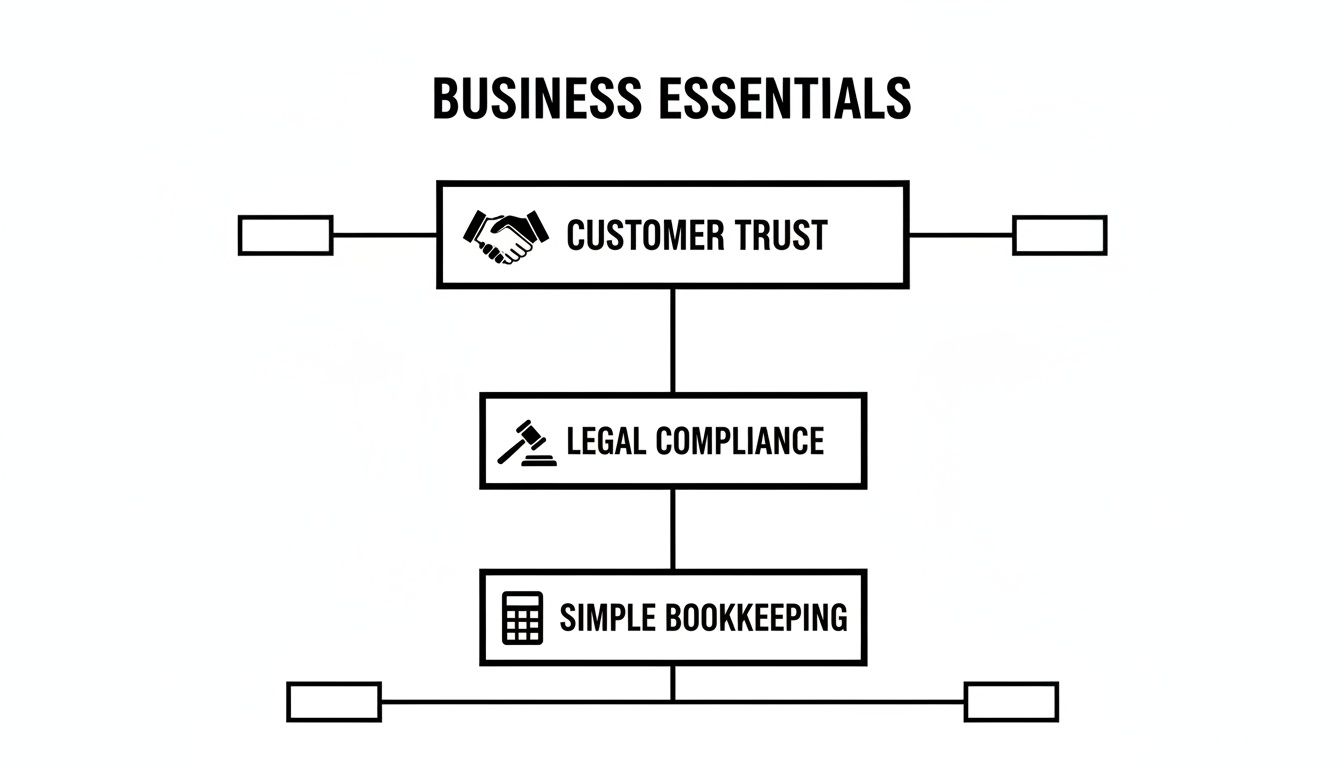
As you can see, customer trust, legal compliance, and simple bookkeeping are all tied together. A well-designed receipt is the common thread that connects them all. Now, let's dive into the specific fields that make it all work.
Essential Fields for Your Restaurant Receipt Form
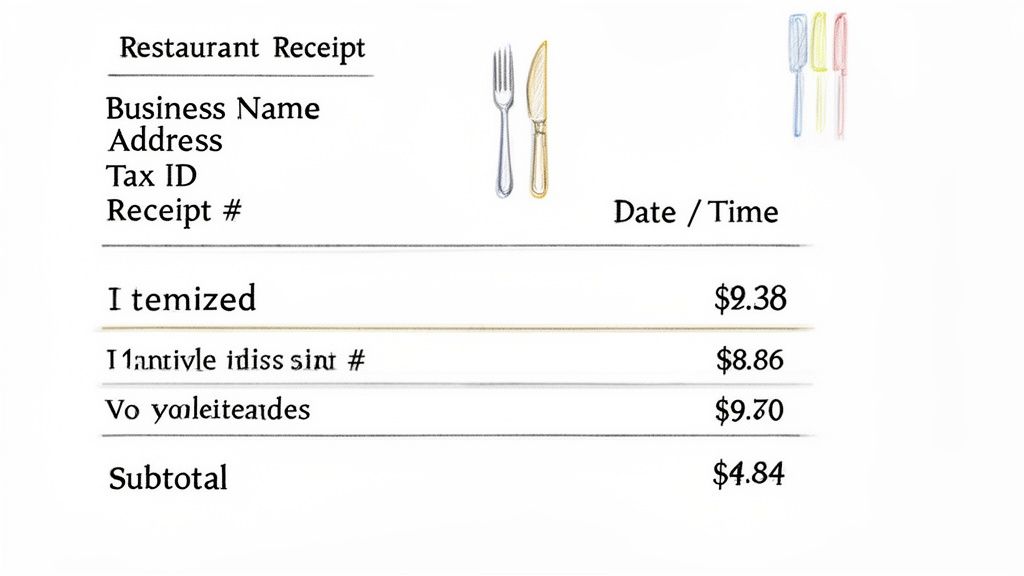
Before we get into the nitty-gritty, here’s a quick-glance table of everything your receipt absolutely must include. Think of this as your pre-flight checklist for creating a document that’s both professional and legally sound.
| Component | Description | Why It's Important |
|---|---|---|
| Business Info | Your restaurant's name, address, and phone number. | Establishes identity and provides crucial contact info for customers. |
| Tax/Business ID | Your official government-issued business identification number. | A legal must-have, especially for customers expensing their meals. |
| Receipt ID | A unique number assigned to each individual transaction. | Makes it easy to look up a specific sale for refunds or disputes. |
| Date & Time | The exact date and time the transaction occurred. | Essential for accurate bookkeeping and resolving any payment questions. |
| Itemized List | A line-by-line breakdown of all items purchased with prices. | Provides transparency and builds trust by showing exactly what was ordered. |
| Subtotal | The total cost of all items before any taxes are added. | Clearly separates the cost of goods from mandatory government charges. |
| Taxes | The sales tax amount applied to the subtotal. | Shows compliance with local tax laws and explains the final cost. |
| Grand Total | The final, all-inclusive amount the customer paid. | The single most important number on the receipt; it must be clear and correct. |
Getting these fields right isn't just about looking professional—it’s about creating a functional, compliant document that serves both you and your customer.
Who You Are: Your Business Identity
First things first, every receipt has to clearly state who you are. This isn't just about branding; it's a fundamental requirement for a valid proof of purchase.
- Restaurant Name: This should be front and center, displayed prominently at the very top. It’s the most obvious element, so make it pop.
- Address and Phone Number: This is essential for a customer's records and gives them a way to contact you about their order if needed.
- Tax ID / Business Number: This is completely non-negotiable for legal compliance. It’s also required for any customers who plan to claim the meal as a business expense.
The When and Where: Transaction-Specific Details
Next up, the receipt needs to pin the transaction to a specific moment in time. These details are your best friend when it comes to internal record-keeping and are absolutely vital for resolving any potential customer disputes down the line.
A unique receipt number, for instance, allows you to instantly find the exact transaction in your system.
A receipt missing a date or a unique ID is practically useless for accounting or sorting out a payment issue. These little details provide the verifiable proof that makes the document legitimate.
Let's say a customer calls questioning a charge from last Tuesday. If your receipt includes the date, time, and a unique ID, you can pull up their order in seconds. Without it, you’re stuck scrolling through a sea of transactions, creating a frustrating experience for everyone. A solid generic POS receipt template, like the one here https://receiptmake.com/template/Generic-POS-Receipt, will always have these tracking fields built-in so you're covered.
The What: A Clear, Itemized Breakdown
This is the heart and soul of any good restaurant receipt. A vague bill is a recipe for distrust, so a crystal-clear, itemized list is crucial for keeping your customers happy and confident in their purchase.
- List Each Item Separately: Every dish, every drink, and every add-on needs its own line. No exceptions.
- Use Clear Descriptions: "House Burger" is a thousand times better than an internal code like "Spec #1." Use names your customers will actually recognize.
- Show the Price for Each Item: Transparency is everything. Customers need to see exactly what each part of their meal cost.
This level of detail really matters. With nearly half of all food allergy-related deaths linked back to restaurant food, clear itemization can even be a safety feature, helping diners double-check what they consumed if they have a reaction.
One final pro-tip: as you design the layout, don't forget about the final printed product. It's worth understanding print bleed to ensure a clean, edge-to-edge finish. This small technical step prevents those ugly white borders and gives your receipt a polished, high-quality feel that reflects the amazing dining experience you provide.
Getting Totals, Taxes, and Tips Right Every Time
The bottom of the receipt is where it all comes together. It’s the final handshake, the last impression you leave with your guest. If the numbers are confusing or seem off, it can sour an otherwise great meal. Nailing this final section is all about clarity—it makes paying the bill quick, easy, and transparent for everyone involved.
It all starts with a clearly labeled Subtotal. This number shows the guest exactly what they paid for their food and drinks, before anything else is added. Think of it as the foundation. It separates the cost of the meal from taxes and tips, giving customers a clean starting point.
Calculating and Displaying Taxes Correctly
Next up: taxes. Whether it’s sales tax, VAT, or another local requirement, you have to list it clearly. This isn't optional—it's the law.
The key is to show your work. Always display the tax as its own line item, calculated from the subtotal. For instance, if a meal costs $50.00 and your local tax is 8%, the receipt should spell it out: "Sales Tax (8%): $4.00." This kind of transparency is a must for customers who need to track expenses and helps you keep your own books in perfect order.
Your receipt's financial summary tells a story. Each line—subtotal, tax, tip, and total—needs to follow a logical path, making it simple for anyone to see how you got to the final number they owe.
This is where automated tools really shine. If you're using a gas receipt template or a generic sales receipt from a platform like ReceiptMake, the math is done for you. It completely removes the chance of human error and ensures every single bill is accurate.
Designing a User-Friendly Tip Section
The tip section is probably the most interactive part of the receipt. A good design doesn't just encourage a tip; it makes the process painless for the customer. And those tips are more important than ever.
According to Square’s 2024 Fall Restaurant Report, the average tip on a restaurant transaction in the U.S. was 15.4%, with tips making up about 23% of a restaurant worker’s income. This is why so many places now add suggested percentages to help guide customers and make their own record-keeping easier. You can learn more about recent tipping trends from Square's report.
Here are a few pointers from my experience:
- Offer Suggested Percentages: Do the math for your customers by including suggestions like 15%, 18%, and 20%. It’s a gentle nudge that most people appreciate.
- Keep a Blank Tip Line: Some guests prefer to calculate their own amount. Always include a blank line for a "Custom Tip" to give them that freedom.
- Provide a Clear Final Total Line: Make sure there's a bold, obvious line for the "Total" where the customer can write in the final sum after adding their tip.
This setup covers all your bases. It helps the customer who wants a quick suggestion and the one who wants to do it themselves. You can see a great example of this on this printable blank receipt template, which keeps the final step of payment incredibly straightforward.
The All-Important Grand Total
And finally, we arrive at the Grand Total. This is the big one. It needs to be the most prominent number in the whole financial summary—bold, large, and impossible to miss. It’s the subtotal plus tax and any tip the customer has decided to add.
Whether this number is pre-printed after a credit card transaction or left for the customer to fill in, there can be no ambiguity. A clear grand total prevents payment mistakes, cuts down on questions, and wraps up the dining experience on a professional, trustworthy note.
Turning Your Receipt into a Branding Opportunity
Think about the last impression you leave with a guest. Long after the plates are cleared, the receipt is often the final piece of your restaurant they interact with. It's so much more than a simple transaction record; it's your last chance to reinforce your brand and make the entire experience feel complete.
A generic, flimsy piece of paper can leave a customer feeling like the experience ended abruptly. But a well-designed receipt that reflects your brand’s personality? That feels intentional and professional. It's a small detail, but in the restaurant business, details are everything.
Infusing Your Brand Identity
Your branding doesn't stop at the menu or the decor—it should extend all the way to the receipt. Making it visually consistent with the rest of your restaurant is key to building brand recognition and a stronger connection with your guests.
Here are a few simple but incredibly effective ways to do just that:
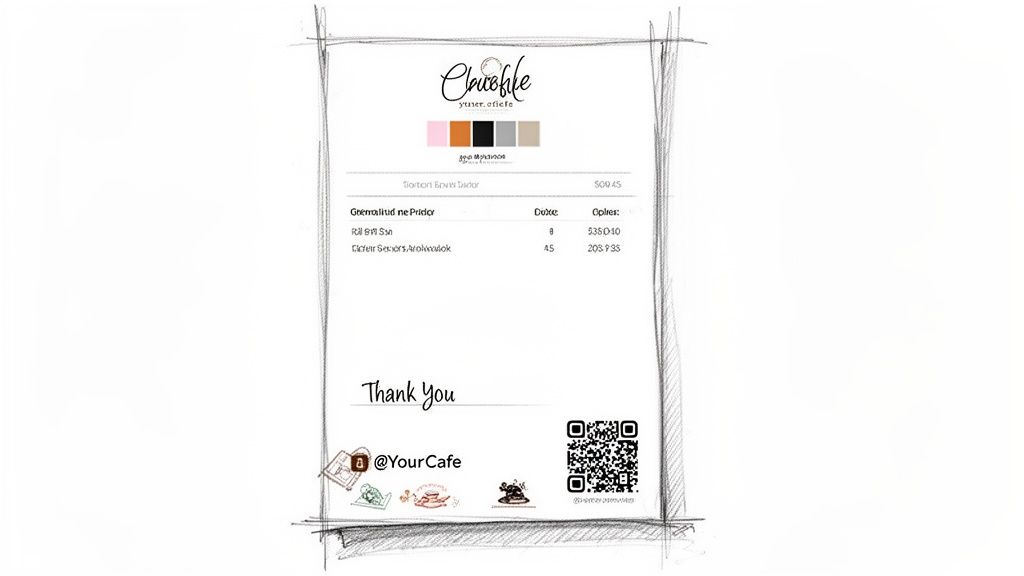
- Lead with Your Logo: Your logo should be right at the top, clear and prominent. It’s the visual handshake that immediately identifies the receipt as yours.
- A Splash of Brand Color: While thermal printers are usually black and white, digital receipts are your playground. A hint of your signature color in the header or footer can make your receipt pop and look far more custom.
- Find the Right Font: The font you choose says a lot. An elegant serif font might perfectly suit a fine dining establishment, while a clean, modern sans-serif feels right at home in a bustling cafe. Just make sure it's always easy to read.
These small touches work together to create a document that feels cohesive and professional, silently communicating the same quality and care you put into your food. A good cash receipt template can serve as a great starting point for integrating these brand elements.
Beyond the Numbers Customer Engagement
Truly great receipts do more than just list charges. They use that valuable space to engage with the customer one last time, turning a financial document into a conversation starter.
A simple "Thank You for Dining With Us!" completely changes the tone of a receipt. It transforms a cold, transactional record into a warm, personal note of appreciation.
Think about adding elements that invite your guests to connect further. Listing your social media handles (like @YourRestaurant on Instagram) is a fantastic way to grow your online community. You could also pop a QR code on there that links directly to a feedback survey or your Google Reviews page. This makes it effortless for happy customers to sing your praises online.
If you’re looking for ideas on how to pull all this together, exploring various receipt templates can be a huge source of inspiration. Seeing how different layouts handle branding and engagement elements can help you design a receipt that not only looks great but also works hard for your business.
Integrating Payments and Digital Options
The way people pay for things has changed, and our restaurant receipts need to change right along with them. Long gone are the days when a simple "cash paid" stamp was enough. Now, with so many payment options out there, your receipt needs to clearly spell out how the bill was settled. This isn't just about good record-keeping; it's about protecting your business and your customers.
Think about it from a practical standpoint. When a customer uses a credit card, including the last four digits and the card type (like Visa or Amex) is a must. It's a simple, clear reference point for everyone involved.
And don't forget the authorization code. That little string of numbers is your definitive proof that the payment went through. Having it printed on the receipt can be a lifesaver if you ever need to deal with a chargeback or simply verify a transaction down the line.
Accommodating Modern Payment Methods
Restaurant receipts are finally catching up to the reality that cash is no longer king. With credit cards making up around US$29.8 billion in yearly restaurant sales in the U.S. alone, the payment section has become critical real estate. For that reason, you'll see fields for the last four digits of the card, the brand, and the authorization code on nearly every modern receipt. These details are non-negotiable for handling disputes and staying compliant. If you're curious about the numbers, you can explore more statistics on restaurant payment methods to see just how dominant cards have become.
It’s not just about traditional credit cards, either. People are using contactless payments and digital wallets like Apple Pay more and more. Adding a quick note like "Payment Method: Contactless" is a small touch that goes a long way. It helps customers immediately recognize the charge on their bank statement, avoiding any confusion. A good credit card receipt template will have these fields built in.
A well-documented payment section is more than just good practice—it's your first line of defense. Clear, specific payment details can instantly resolve disputes and provide the evidence needed for any financial reconciliation.
Of course, accepting these payments means having the right technology in place. There are tons of digital payment solutions for businesses out there, and exploring them can give you a good sense of what might work best for your setup.
Bridging Physical and Digital with QR Codes
One of the easiest and most effective ways to bring your receipts into the modern era is with a simple QR code. It’s a fantastic little tool that connects the paper in your customer's hand to a whole world of digital convenience.
A single QR code can do so much:
- Link to a Payment Portal: Let guests scan and pay right from their phones. This is a game-changer for turning tables faster.
- Offer Digital Receipt Downloads: Give customers a quick way to save a PDF of their receipt for expenses or records.
- Direct to a Feedback Form: Encourage feedback while the experience is still fresh in their minds. It's much more effective than sending an email a day later.
By adding these kinds of digital touches, you're meeting your customers where they are—on their phones. You're showing them you value their time and convenience. If you want to see how this works in practice, you can play around with a receipt generator to create a form with a QR code. It’s a great way to make your receipt a tool for the future, not just a record of the past.
Common Questions About Restaurant Receipts
Even with the best plan, you're bound to have a few questions when putting together your restaurant's receipt. Let's tackle some of the most common ones I hear from restaurateurs.
Do I Legally Need to Provide an Itemized Receipt?
The short answer is yes, you almost certainly do. While the exact laws can differ from state to state or country to country, providing a fully itemized receipt is standard practice for a reason. For any kind of tax reporting, like sales tax or VAT, a detailed breakdown is an absolute must.
But beyond the legal stuff, think about it from the customer's perspective. A clear, itemized bill builds trust and prevents confusion or disputes over charges. It also makes it easy for them to expense a business meal. Skipping this step looks unprofessional and can land you in hot water with local tax or consumer protection agencies.
What Is the Best Format for a Digital Restaurant Receipt?
When it comes to digital receipts, PDF is the gold standard. There's really no debate here. It's a universal format that locks in your design—the layout, fonts, and your logo will look exactly as you intended on any phone, tablet, or computer.
Unlike a Word doc or a simple image file, a PDF is secure and can't be easily altered. It gives customers a clean, print-ready copy they can save for their records. Using a tool that spits out a high-quality PDF is the most professional way to go.
Think of a PDF receipt as a sealed envelope. It protects the details of the transaction, giving both you and your customer a secure, unchangeable record.
How Can I Create a Custom Restaurant Receipt for Free?
These days, you don't need fancy software to create a professional-looking receipt. You can knock one out for free using a simple online tool. A platform like ReceiptMake is perfect for this because you can get started right away—no downloads, no sign-ups.
It really is as simple as it sounds:
- Pick a starting point: Grab a pre-made design that fits your vibe, whether it's a classic restaurant bill template or something specific like a pizza receipt.
- Plug in the details: Type in your restaurant's name, address, and drop in your logo. Then, add the food and drink items for the order.
- Download and go: The tool does all the math for you, calculating taxes and totals on the fly. You can then download a polished PDF that’s ready to be printed or emailed to your customer.
This whole process takes just a few minutes and leaves you with a custom receipt that looks great. Whether you need a simple bar receipt or something more complex, these tools are a fast, reliable, and totally free solution.
Ready to create a professional restaurant receipt that builds trust and keeps your records straight? With ReceiptMake, you can generate beautiful, accurate receipts in seconds. Choose from over 100 templates, add your branding, and download a print-ready PDF for free. Start designing your perfect receipt today at https://receiptmake.com.

