How to Balance a Cash Drawer Perfectly Every Time
At the end of a long shift, knowing how to balance a cash drawer boils down to a simple truth: the total cash in your drawer, minus the starting float you began with, must equal the total cash sales your system recorded for that shift. Getting this daily check right is the single most effective way to guard your profits against simple mistakes and even theft. Creating a clear invoice receipt for each transaction is a fundamental step in this process.
The True Cost of an Unbalanced Till
We’ve all felt it—that sinking feeling in your stomach when the final cash count is off. It’s not just about a few missing dollars; it's a direct hit to your profit margin. For any small business owner, finding a discrepancy after a long, hard day is beyond frustrating. But this daily ritual is so much more than a tedious chore. It's your business's financial health check.
Perfecting this skill is non-negotiable, especially when small operational errors can chew through your bottom line faster than you'd think. Here's a crucial point to remember: every dollar that goes unaccounted for comes straight out of your net profit, not your gross revenue. That's money you could have used for inventory, payroll, or your own pocket.
Why Every Single Dollar Matters
It's easy to dismiss cash as a thing of the past, but the numbers tell a different story. In 2023, cash was still used for 16% of all payment transactions in the U.S. It’s not going anywhere, and for businesses managing cash drawers, this daily balancing act is a vital shield against major losses.
Consider this: retail "shrink," which includes everything from shoplifting to cash discrepancies, ballooned to $112 billion in 2022. That's a staggering 19% jump from the year before. Simple register errors and administrative mix-ups quietly erode profits that are often already razor-thin—sometimes under 5% in retail. You can read more about how critical cash management is to retail profits from Sesami.io.
This makes it crystal clear why balancing your drawer is one of the most important things you'll do each day. It’s not just about catching mistakes. It’s about building a culture of accountability and precision that protects the money you work so hard to earn. A detailed hotel receipt for hospitality businesses, for example, is part of this precision.
To truly grasp the importance of this daily task, let's look at the concrete reasons why accurate balancing is a must-have for any business.
Why Accurate Cash Balancing Matters
| Reason | Impact on Your Business | Example Scenario |
|---|---|---|
| Profit Protection | Directly prevents cash loss from errors or theft, safeguarding your bottom line. | A cashier consistently miscounts change, leading to a small daily shortage. Over a year, this "small" error adds up to thousands in lost profit. |
| Error Detection | Helps you quickly identify and correct issues, like incorrect change or pricing errors. | The drawer is over by $20. You trace it back to a customer who paid for a $30 item with a $50 bill but was given change for a $100. |
| Theft Deterrence | Regular, meticulous counting makes it much harder for internal theft to go unnoticed. | An employee knows the drawer is balanced to the cent every night, discouraging them from pocketing cash. |
| Financial Accuracy | Ensures your accounting records are correct, which is essential for taxes and business planning. | Your sales reports match your bank deposits perfectly, making bookkeeping and tax filing clean and straightforward. |
In the end, this process is about maintaining the financial integrity of your operations. Without it, you're flying blind.
At its core, balancing a cash drawer is an act of financial stewardship. It transforms abstract sales data into tangible results, giving you a clear, honest look at your daily performance.
Your First Line of Defense
The process of balancing a cash drawer actually starts long before you count the first bill. It begins with solid, meticulous record-keeping throughout the entire day. Your records are your first and best defense against discrepancies later on.
Here’s why that consistent documentation is so important:
- It Creates a Clear Paper Trail. Every single transaction needs a record. This makes it infinitely easier to trace any inconsistencies back to the source when something doesn't add up.
- It Simplifies Reconciliation. When your POS sales report and your physical receipts are in sync, the final count is just a verification process—not a full-blown forensic investigation.
- It Helps You Spot Patterns. Tracking discrepancies over time can reveal recurring problems. Maybe an employee needs a bit more training on handling returns, or perhaps a scanner is misreading a specific barcode.
Using a professional and consistent tool for your records is simply non-negotiable. For instance, generating a clear and detailed cash sale receipt template for every transaction gives you the hard proof needed to verify sales and sort out issues fast. This one simple habit sets you up for a smooth and accurate end-of-day count, turning a potentially stressful task into a straightforward routine.
Getting Ready for a Perfect Count
Believe it or not, a smooth end-of-day count doesn't start with counting cash. It starts way before the last customer walks out the door. Getting your setup right turns what could be a headache into a simple, predictable routine. Think of it like a chef preparing their ingredients—everything in its place makes the final dish come together perfectly.
The absolute foundation of this whole process is your starting float. This is the set amount of cash you kick off every shift with, usually somewhere between $100 and $300, just to have enough change on hand. It's not just a random wad of bills; it should be a specific mix of bills and coins that's the same every single day. This consistency gives you a solid, reliable baseline to work from, which makes the final math a breeze.
Your Pre-Count Checklist
Once you've closed up, where you count is just as important as how you count. Find a quiet spot away from any lingering customers or distractions. A back office is perfect. Interruptions are the number one reason for miscounts, so a little peace and quiet goes a long way.
Before you touch a single bill, get your gear together. You don't want to be hunting for a pen or a report halfway through.
- Your Cash Count Sheet: This is your guide for tallying up all the denominations.
- The POS Sales Report: The official system record of everything you sold.
- Any Payout Slips or IOUs: Notes for any cash that was taken out for tips, supplies, or other approved reasons.
- A Calculator: Your best friend for double-checking the numbers.
Having everything you need within arm's reach keeps you focused and helps the whole process flow smoothly.
A great count is 90% preparation and 10% execution. If you standardize your float and create a calm counting space, you’ve already eliminated the most common reasons for errors.
Why a Paper Trail Matters
A solid paper trail is your safety net when it's time to reconcile. This means having a clear, itemized receipt for every cash transaction, no exceptions. For places like small shops or markets, using a consistent convenience store receipt template ensures every sale is documented the same way. When a number doesn't add up, this documentation makes it incredibly simple to trace it back to the source.
This might seem a little old-school, but it's a vital defense against shrink from register errors. Properly balancing your drawer is a classic, time-tested way to slash those losses. It’s the ritual that confirms your physical cash matches your digital sales records—a discipline that's still crucial, especially when you consider cash still made up 16% of all U.S. payments in 2023. Taking these prep steps seriously means you're set for a perfect count, every single time.
Your Systematic Guide to Counting and Reconciling
Alright, you've got your space cleared and your tools ready. Now for the main event: the count itself. The real goal here isn't just to tally up the cash, but to follow a rock-solid process every single time. A methodical approach is what separates a quick, painless closeout from a frustrating hunt for a missing dollar. It transforms a potentially stressful task into a simple verification.
This simple flowchart shows how a little prep work—setting aside your float, clearing your space, and grabbing your reports—lays the groundwork for a perfect count.
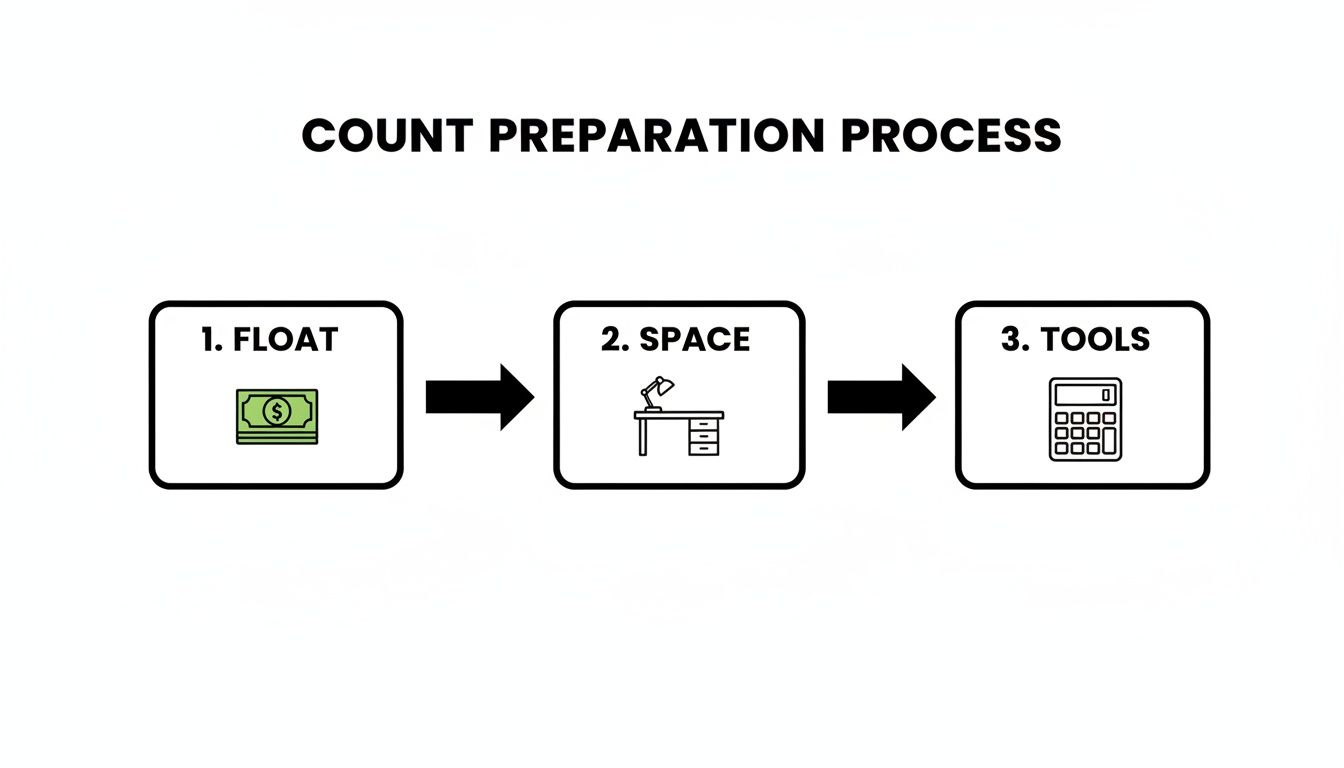
As you can see, a successful count is built on being ready. It's about having a clear starting point, a focused environment, and all the numbers you need right in front of you.
The Initial Cash Count
First things first: get your starting float out of the drawer. If you started the day with $150, physically remove that exact amount and set it completely aside. That money isn't revenue; it's the baseline you began with. Forgetting to separate the float is probably the most common mistake people make, so make it a habit to do it before anything else.
With the float out of the picture, you can focus on counting the day's earnings. Don't just dive into a mixed pile of cash and coin. Take a minute to sort everything by denomination. It makes a world of difference.
- Stack your bills into separate piles: $20s, $10s, $5s, and $1s.
- Group your coins by type: quarters, dimes, nickels, and pennies.
Organizing like this keeps you from losing your place or accidentally counting the same bill twice. Count each stack, jot down the total for each denomination on your count sheet, and then add it all up. The final number is your Total Cash on Hand.
Reconciling Against Your Sales Report
You've got your physical cash total. Now, let's see how it lines up with the digital record. Your point-of-sale (POS) system has been tracking every sale, giving you the exact amount of cash you should have collected.
Pull the sales report for your shift. You're looking for one specific number: Total Cash Sales. This is your target. The formula for balancing the drawer is beautifully simple.
(Total Cash on Hand) - (Starting Float) = Expected Cash Sales
If your calculated total matches the Total Cash Sales on the POS report, you’re golden. For instance, if your drawer holds $975.50 and your float was $150, your actual cash sales come out to $825.50. If the POS report says the same, you're perfectly balanced and can close out with confidence.
The Role of Receipts in Verification
But what if the numbers don't line up? That's when your paper trail becomes your best friend. A clear, detailed receipt for every transaction is the proof you need to figure out what went wrong. A simple typo when keying in cash received or a payout that wasn't logged can throw off your entire count.
When you're hunting for a $20 discrepancy, being able to quickly cross-reference your cash with individual transaction records is everything. This is precisely why using a standard record, like a generic POS receipt, for every single cash transaction is such a vital practice. It guarantees that the date, time, items, and total are always captured, making it much easier to spot the one transaction that's causing the problem. Without that proof, you’re just left guessing.
Troubleshooting Discrepancies Like a Pro
It happens to the best of us—you finish the count, and the numbers just don’t match. That little jolt of panic is normal, but the key is to replace it with a calm, methodical process. Don't just start recounting randomly; turn that moment of stress into a structured investigation.

The issue could be as simple as a miscount or handing back the wrong change. Don't immediately jump to worst-case scenarios. Having an effective troubleshooting guide template in place can make a world of difference, turning a potential headache into a smooth, fast fix.
Your Step-by-Step Investigation
So, your drawer is over or short. What now? The first step is always the easiest: double-check your own work. Recalculate your count sheet and verify your math. It's surprisingly easy to make a small addition error after a long shift.
If the numbers still don't line up, it’s time to dig into the transaction log on your POS system. Look for anything that stands out, like unusually large cash sales, voids, or manual discounts.
Next, physically compare your receipts against that transaction log. Did a big cash payment get keyed in wrong? Sometimes a quick side-by-side check will pinpoint the exact moment things went off track. In a retail setting, having a standard clothing store receipt makes this comparison much easier.
Finding the Common Culprits
Most of the time, shortages and overages come down to simple human error. Before you get too worried, run through this list of usual suspects. These account for the vast majority of balancing issues and are often easy to spot once you know what to look for.
- A Simple Miscount: This is the most frequent cause. It's easy to count a stack of $10s as $20s when you're tired. A careful recount is your best first move.
- Incorrect Change: Giving a customer change for a $50 bill when they actually paid with a $20 is a classic, costly mistake.
- Missed Payouts: Someone grabbed $15 for supplies but forgot to leave a payout slip. Now you’re short with no paper trail.
- Transposed Numbers: You wrote down $45.20 on the count sheet when the total was actually $42.50.
Remember, the goal here is to find the source of the problem, not to place blame. A calm review of the day's transactions will almost always reveal the cause.
Expert Tip: Every discrepancy, no matter how small, must be documented. Tracking these incidents helps you spot recurring patterns, which might point to a need for more training or a clearer cash-handling policy.
The financial impact of these "small" errors adds up faster than you'd think. On average, cash handling costs retailers 9.1%, but that number can spike to a staggering 15.5% in high-volume settings like bars and restaurants.
As a report by IHL Group highlighted, a seemingly tiny 1% discrepancy on $2,000 in sales is a $20 loss. That single drawer could lose over $600 a year. This is where having rock-solid documentation becomes crucial.
Common Discrepancy Causes and Solutions
To help you get to the bottom of things quickly, here’s a quick-reference table for the most common issues I’ve seen over the years and how to solve them.
| Common Cause | How to Identify It | Recommended Action |
|---|---|---|
| Simple Math Error | Recalculating the count sheet or sales report reveals a different total. | Double-check all addition and subtraction on your balance sheet. Use a calculator. |
| Incorrect Change Given | Review sales log for odd-numbered totals or transactions just before a customer complaint. | Recount the drawer one more time. If unresolved, note the discrepancy and discuss with staff. |
| Missing Payout Slip | The drawer is short by a round number (e.g., $10, $20) and no receipt is present. | Ask staff if anyone made a purchase or payout. Implement a strict "no slip, no cash" rule. |
| POS Entry Error | A physical receipt doesn't match the amount in the POS system. | Compare the day's physical receipts to the POS transaction log, looking for mismatches. Correct the entry. |
| Sticky Bills or Coins | Two bills were stuck together, or coins were stuck in the drawer tray. | Physically remove the cash tray and check underneath. Flip through each stack of bills carefully. |
This table should be your go-to guide whenever you hit a snag. Most of the time, the solution is right there in front of you—you just need a system to find it.
Building a Bulletproof Cash Management System
Balancing a single cash drawer is a daily chore, but building a system around it is a long-term strategy for protecting your business. It's about moving beyond just the nightly count and establishing consistent habits that ensure both accuracy and security. A solid system stops problems before they start, turning a reactive task into a proactive defense.
This all starts with clear, written cash-handling policies. Every single staff member needs to understand the rules for everything—from making change and handling customer refunds to processing voids and payouts. Consistency is the bedrock of a secure system.
Creating Long-Term Habits for Accuracy
One of the best ways I’ve found to keep standards high is to perform regular, unannounced spot checks. These aren't about trying to catch someone messing up. They're about reinforcing that accuracy matters all day, every day, not just at closing. A quick drawer count during a slow period can highlight training needs and keep everyone on their toes.
Another simple but powerful habit is to keep the cash in your drawer to a minimum. A till stuffed with cash is a magnet for theft and a huge security risk. Set a clear maximum cash limit for the drawer and have a manager perform cash drops into a secure safe or deposit bag whenever that limit is hit.
The goal of a cash management system isn't just to find discrepancies; it's to create an environment where they rarely happen. It's about building a culture of accountability from the top down.
For businesses looking to really tighten their security, bringing in professional loss prevention services can be a game-changer and a critical part of a robust strategy.
Modern Tools and Secure Procedures
Modern tools can make a huge difference here. Using standardized templates for your transactions creates a uniform paper trail that's a lifesaver when you're trying to track things down. For instance, making sure every sale is documented with a detailed restaurant bill removes any guesswork during reconciliation. It gives you a clear record you can instantly check against your POS report.
Your system also needs to cover what happens after the cash leaves the drawer. You need ironclad procedures for getting that money to the bank safely.
- Use a Secure Location: Always prep the bank deposit in a back office or secure area, away from public view. Never count large sums of cash on the front counter.
- Vary Your Routine: Don't be predictable. Avoid making bank runs at the exact same time every day. It's a simple security trick that works.
- Use Tamper-Evident Bags: These bags immediately show if someone has tried to get into the deposit before it reaches the bank.
- Log Every Deposit: Keep a simple deposit logbook to track the date, amount, and the name of the employee who took it to the bank.
By weaving together clear policies, regular checks, and secure daily procedures, you build a system that truly protects every dollar you earn. This comprehensive approach is what separates the pros from the amateurs when it comes to cash management.
Answering Your Top Questions About Balancing a Cash Drawer
Even with a great system in place, you're bound to run into a few tricky situations when you're balancing the till. Let's tackle some of the most common questions I hear from business owners and managers.
What Should I Do if the Drawer Is Over?
It's tempting to see an overage as a bonus, but it's really just a different kind of mistake. An overage means an error happened somewhere, most often when a customer was short-changed or accidentally paid too much.
Don't just pocket the extra cash. You need to document the overage on your balance sheet with the same detail you'd use for a shortage. Keeping a close eye on overages can help you spot patterns. If the same cashier is consistently over, it might just mean they need a little extra training on making change.
How Often Should I Balance the Cash Drawer?
The golden rule is at the end of every single shift. This is not something you want to skip. Balancing daily means you catch mistakes while the day’s transactions are still fresh in everyone’s memory.
If you let it slide for even a day or two, trying to track down the source of an error becomes a massive headache. And if you have multiple people working the same register, it's a smart move to balance the drawer every time you swap cashiers.
What Is the Best Way to Handle Payouts?
Every time cash leaves the drawer for a reason other than giving change, you need a paper trail. No exceptions. A simple "paid out" slip is all it takes. It should have the date, the amount, the reason for the payout (like "office supplies" or "window cleaning tip"), and a signature from the employee who handled it.
Without a physical slip, a payout is just a shortage waiting to happen. That little piece of paper is your only proof of where the money went when you're trying to reconcile later.
This simple habit eliminates the guesswork and keeps everything above board. Using a standard petty cash receipt template is a great way to make sure everyone captures the same information every time.
Can I Use Digital Tools to Help?
Of course. You'll always have to do the physical cash count by hand, but technology can make the record-keeping part so much easier. Creating a digital receipt for every single sale gives you a clean, searchable record to match against your cash.
For instance, when you generate a crisp sales receipt for a retail purchase or a specific taxi receipt for a fare, you're building a reliable digital history. This makes tracking down discrepancies a breeze because you can quickly cross-reference your till report with your actual sales records. When you combine a meticulous physical count with solid digital proof, your system becomes practically bulletproof.
Ready to create a flawless paper trail for your business? With ReceiptMake, you can generate professional, accurate receipts for every transaction in seconds. Choose from over 100 templates to keep your records clean and make balancing your cash drawer easier than ever. Start creating free receipts now at https://receiptmake.com.

